
Projects
A diverse set of projects targeting explainable medical AI
To reach the KEMAI research goals, we have put together a set of diverse PhD projects in the areas of computer science, medicine, ethics and philosophy. The following outlines are examples of such projects. We expect that KEMAI doctoral researchers work on one of these projects, or an alternative project suggested by themselves, which fits under the KEMAI umbrella.
Below is a list of our project proposals, organized by research topic area. These areas of focus include Data Exploitation, which involves harvesting medical guidelines and investigating contrastive pre-training; Knowledge Infusion, which enriches learning models with medical guidelines; Knowledge Extraction, which derives medical guidelines from trained models; and Model Explanation, which communicates the decision process of trained models. Each project is designed to advance our understanding and application of these key areas, contributing to the overall improvement of medical diagnostics and treatments through cutting-edge research and technology.
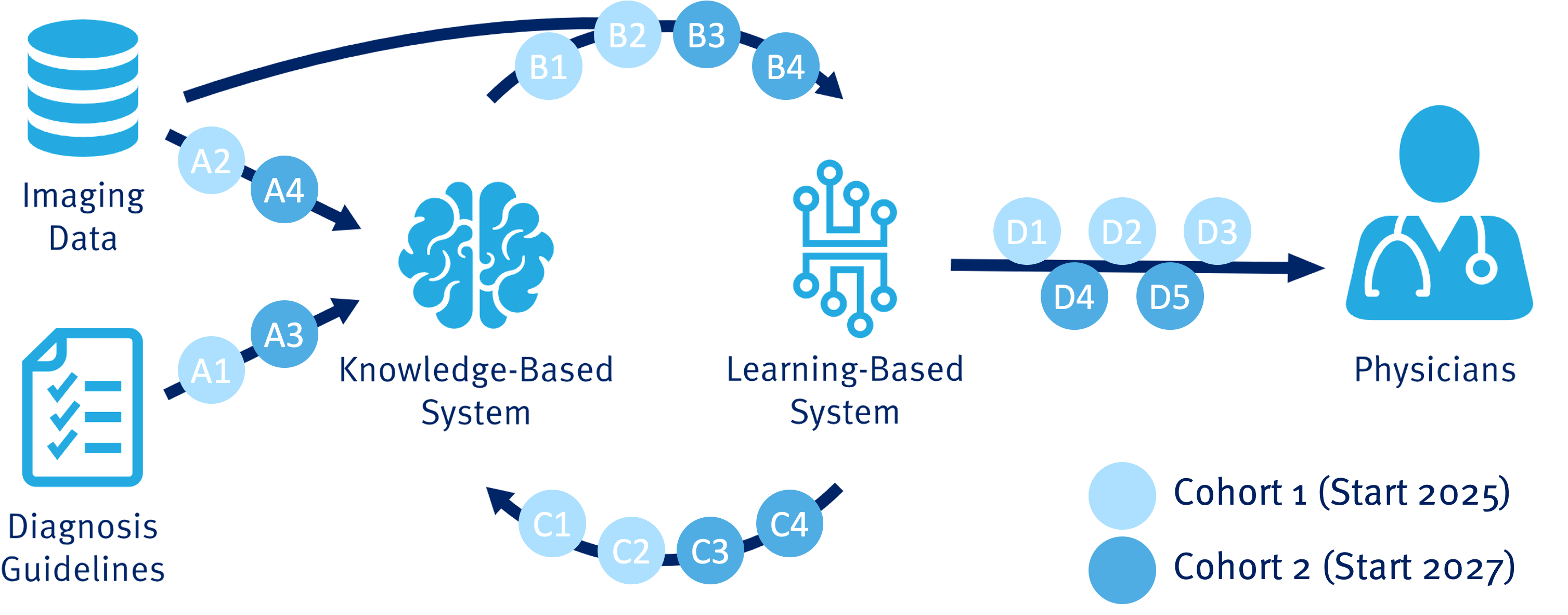
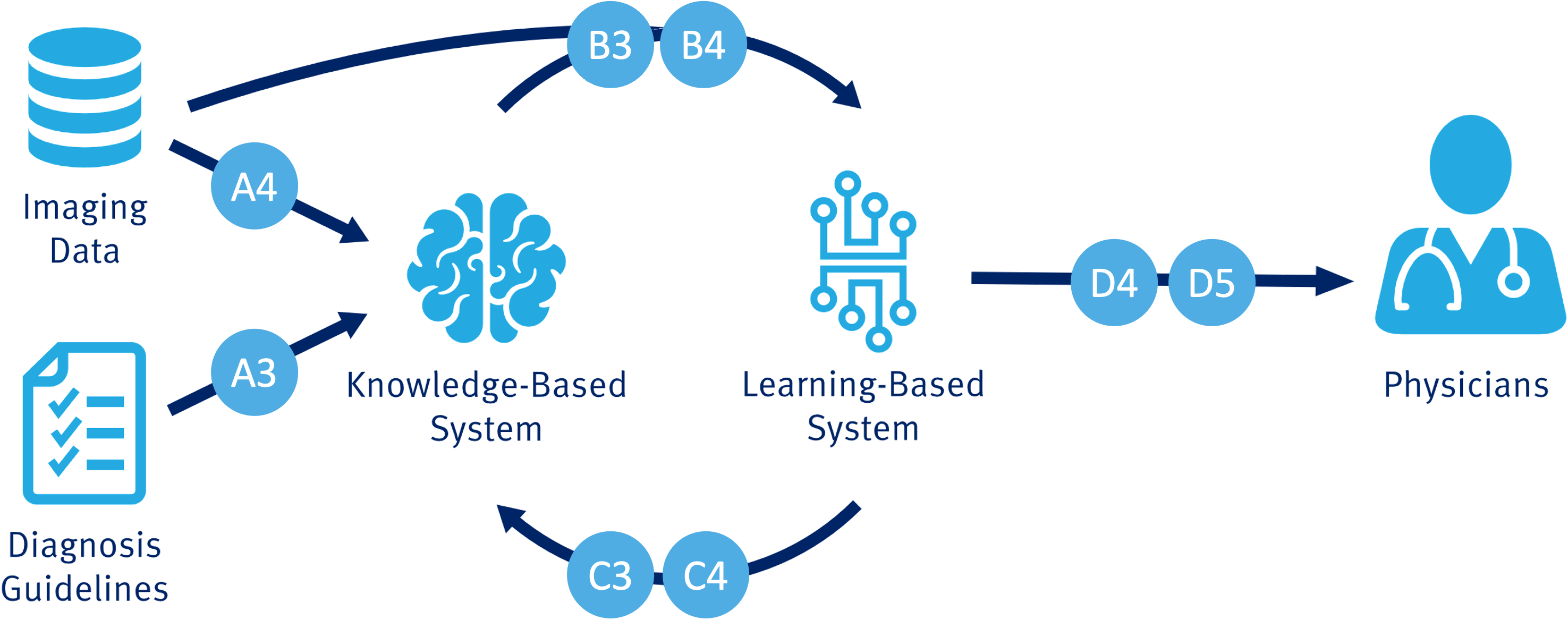
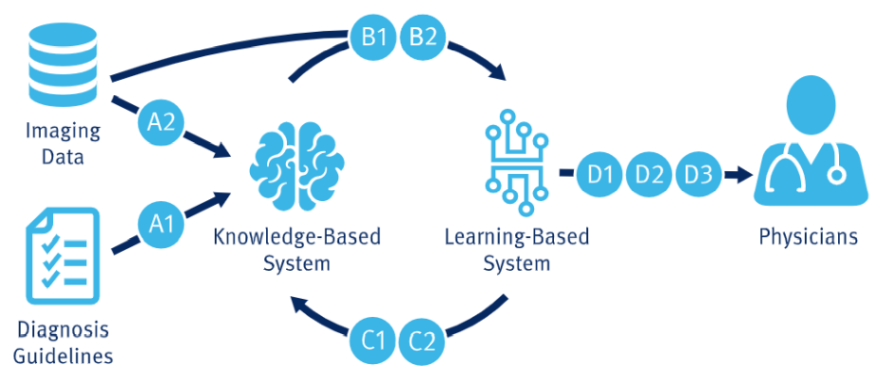
The projects are organized into two cohorts. The figure below shows all projects across both cohorts and how they contribute towards the overall KEMAI mission, which is detailed on the KEMAI mission page. Use the tabs underneath to view the projects of each cohort.
Positions filled · Start 2027
All positions of this cohort, which starts in January 2027, are filled. KEMAI is currently not accepting new PhD applications.
Data Exploitation
-
A3 – Prototype-based Concept models from sparse annotated medical images
Already assigned/position filled
Project Leads: Prof. Götz (Medicine), Prof. Glimm (Computer Science), Dr. Vernikouskaya (Medicine)
Concept-based AI systems are highly beneficial for answering radiological questions, as they combine high performance with inherent explainability. However, obtaining the necessary training data can be challenging. This project aims to address this limitation by investigating novel approaches to automatically extracting the necessary information from existing data sources during the training process. To achieve this, the project will leverage the potential of pre-training approaches, domain adaptation, and automated text extraction using large language models. The resulting solutions will be evaluated using medical tasks, comparing our existing concept-based approach with potential new approaches, both with and without concepts. -
A4 – Concept-Based Explainable Computer Vision for Medical Diagnosis
Already assigned/position filled
Project Leads: Prof. Ropinski (Computer Science), Prof. Hufendiek (Philosophy), Dr. Lisson (Medicine)
This project develops explainable computer vision methods for medical diagnosis that link model predictions to clinically meaningful visual concepts and decision criteria. It investigates how attention maps, concept-based explanations, and example-based reasoning can be combined to make detection, classification, and segmentation results more transparent. The project evaluates these methods with medical imaging tasks to assess whether they improve interpretability, support error analysis, and increase clinicians’ trust and acceptance of AI-assisted decisions.
Knowledge Infusion
-
B3 – Neuro-Symbolic Reasoning for Medical Imaging
Already assigned/position filled
Project Leads: Prof. Braun (Computer Science), Prof. A. Beer (Medicine)
This project investigates reasoning-based approaches to medical image interpretation, using cancer staging from PET/CT as primary application domain. It addresses two complementary aspects. First, modularization: rather than learning the full mapping from images to clinical decisions end-to-end, we decompose the problem into individually learnable cause-effect pairs and compose them through explicit reasoning at inference time, exploring this as a strategy for generalization when the combinatorial space of possible cases far exceeds available training data. Second, explanation: we investigate how structured reasoning processes can generate not just predictions but candidate hypotheses with supporting and opposing evidence, serving as a reasoning scaffold that makes the system’s logic transparent and useful to clinicians. The project sits at the intersection of neuro-symbolic AI, medical imaging, and clinical decision support, with the broader aim of understanding where the boundary between learning and reasoning should lie in medical AI systems. -
B4 – Trusted and interpretable patterns for mixed-type high-dimensional diagnostics
Already assigned/position filled
Project Leads: Prof. Kestler (Medicine), Prof. M. Beer (Medicine)
High-dimensional diagnostics characterise patients using imaging, molecular profiles, and heterogeneous clinical data such as routine laboratory values and questionnaire responses. This project investigates principled approaches to learning and uncertainty quantification in this setting, addressing two complementary aspects. Heterogeneity: rather than treating mixed-type data as a preprocessing problem, we address the challenge of learning directly from inputs of differing scales and types, exploring how specialized feature encodings, distance measures, and weighting schemes can be integrated into a coherent learning framework suited to the high-dimensional, small-sample regime characteristic of clinical diagnostics. Uncertainty: we investigate how, for example, conformal prediction can provide valid confidence bounds for patterns detected in mixed-type data, defining conformity scores that capture both categorical and numerical variables, with the aim of generating not just predictions but trustworthy, interpretable outputs for clinical use. The project is at the intersection of machine learning, uncertainty quantification, and clinical decision support, with the broader aim of making AI-driven diagnostics reliable and transparent in settings where data are heterogeneous, costly to acquire, and limited in quantity.
Knowledge Extraction
-
C3 – Enriching Ontological Knowledge Bases through Abduction
Already assigned/position filled
Project Leads: Prof. Glimm (Computer Science), Prof. Kestler (Medicine)
This project uses abductive reasoning based on ontological knowledge to explain ML system outcomes. It focuses on developing practical abduction algorithms for consequence-based procedures, extending the deductive reasoner ELK. The research aims to explicate and exploit hidden knowledge in learned systems, benefiting related projects by providing semantic domain knowledge. -
C4 – Investigating Active Vision and Reasoning Mechanisms for Medical Diagnosis
Already assigned/position filled
Project Leads: Prof. Wang (Computer Science), Prof. Neumann (Computer Science), Prof. Götz (Medicine)
The lack of transparency and human-like reasoning in computational vision systems reduces the trust and interpretability of AI-assisted medical diagnosis. This project focuses on active vision and investigates how clinicians perceive and reason about medical images by combining eye-tracking data with verbal descriptions and diagnostic explanations provided by doctors. The project aims to model how experts allocate visual attention, gather information, and form diagnostic conclusions by learning from gaze behavior and semantic reasoning signals. Such methods are evaluated on medical imaging tasks to assess whether they improve interpretability, support error analysis, and increase clinicians’ trust and acceptance of AI-assisted decisions.
Model Explanation
-
D4 – Dual Use Research of Concern with AI-based Medical Diagnoses
Already assigned/position filled
Project Leads: Prof. Steger (Ethics), Prof. Ropinski (Computer Science)
This project addresses the ethical analysis of research with the use of AI and expert systems, which belongs to Dual Use Research of Concern (DURC), as it can be misused with intent to harm human dignity, health, freedom, property or peaceful coexistence. It has become particularly important to not only consider potential military uses and misuses of research, but also examine possible vulnerabilities of systems based on large patient databases to discrimination, extortion through ransomware, theft of sensible data and computer attacks. For example, data of patients with certain diseases can be misused by insurance companies or employers to discriminate them. Therefore, the issue of security-relevant research and DURCs has to be discussed with AI-based Medical Diagnoses in an ethical perspective. Within this project, the research will concentrate on the evaluation of AI systems with regard to protection of individuals and dual use of this technology. A particular focus will lie on the identification of vulnerabilities as well as potential threats related to the use of such systems, e.g., through theft of personal data used in research and clinical applications or through dual use of the developed systems, e.g., for military or criminal purposes. Moreover, it will be examined how such risks can be minimized, e.g., through restriction of personal data gathered from patients or through built-in protection mechanisms and guidelines on how ethically secured systems can be developed. -
D5 – Explainability, Responsibility, and Clinical Judgment in Medical AI
Already assigned/position filled
Project Leads: Prof. Hufendiek (Philosophy), Prof. Glimm (Computer Science), Dr. Hauke Behrendt (Philosophy)
This primarily philosophical project focuses on medical scenarios in which AI systems generate diagnostic or therapeutic recommendations and thereby become involved in potentially high-stakes decisions. The central question is under what conditions such recommendations can be explained in a way that enables responsible clinical judgment, understood not merely as technical transparency but as a practice of justification sensitive to context, stakeholders, and risk.
Medical PhD Projects (10 months, MD)
The outlined PhD projects are complemented by medical PhD projects, which complement the technical and ethical projects, and which are targeted towards medical researchers. The medical PhD projects can be supervised by one of the KEMAI medical partners. In this area, we foresee the following projects:
M1 – Guideline Analysis
This project focuses on systematically analyzing medical guidelines for their integration into AI systems aimed at improving medical diagnostics. The doctoral researcher will assess guidelines, extract relevant rules, and evaluate their impact on AI models with medical practitioners.
M2 – Explanation Ranking
This project aims to evaluate and rank explanation techniques for AI-supported medical diagnoses. The doctoral researcher will develop a taxonomy of explanations and conduct evaluations with medical practitioners to determine their effectiveness.
M3 – Explanation Requirements for COVID-19 CT Imaging
This project focuses on the requirements for explainable AI in COVID-19 CT imaging. The doctoral researcher will analyze the diagnostic process, conduct expert interviews, and propose guidelines for integrating explainable AI.
M4 – Explanation Requirements for Bronchial Carcinoma PET/CT Imaging
Similar to M3, this project addresses the requirements for explainable AI in bronchial carcinoma PET/CT imaging. The research will follow a similar protocol but consider the dual-modality nature of the diagnosis.
M5 – Explanation Requirements for Echinococcosis PET/CT Imaging
Complementing M3 and M4, this project analyzes the requirements for explainable AI in echinococcosis PET/CT imaging. The research will follow a similar protocol, accounting for the rarity and sparse data of the disease.
M6 – LLM Explanation Evaluation
This project investigates the use of large language models (LLMs) to support explainable AI in medical diagnosis. The doctoral researcher will experiment with LLMs, analyze their outputs with medical experts, and identify requirements for future research to enhance their utility.
Past cohort · Start 2025
This is the first KEMAI cohort, which started in 2025. Its positions are filled — the information is retained here for the current Cohort 1 researchers. Note that, to avoid confusion, projects are numbered in an ongoing fashion across cohorts, so the projects below carry the original Cohort 1 numbering.
Data Exploitation
-
A1 – Prototype-based Concept models from sparse annotated medical images
Project Leads: Prof. Götz (Medicine), Prof. Glimm (Computer Science), Dr. Vernikouskaya (Medicine)
Concept-based AI systems are highly beneficial for answering radiological questions, as they combine high performance with inherent explainability. However, obtaining the necessary training data can be challenging. This project aims to address this limitation by investigating novel approaches to automatically extracting the necessary information from existing data sources during the training process. To achieve this, the project will leverage the potential of pre-training approaches, domain adaptation, and automated text extraction using large language models. The resulting solutions will be evaluated using medical tasks, comparing our existing concept-based approach with potential new approaches, both with and without concepts. -
A2 – Concept-Based Explainable Computer Vision for Medical Diagnosis
Project Leads: Prof. Ropinski (Computer Science), Prof. Hufendiek (Philosophy), Dr. Lisson (Medicine)
This project develops explainable computer vision methods for medical diagnosis that link model predictions to clinically meaningful visual concepts and decision criteria. It investigates how attention maps, concept-based explanations, and example-based reasoning can be combined to make detection, classification, and segmentation results more transparent. The project evaluates these methods with medical imaging tasks to assess whether they improve interpretability, support error analysis, and increase clinicians’ trust and acceptance of AI-assisted decisions.
Knowledge Infusion
-
B1 – Neuro-Symbolic Reasoning for Medical Imaging
Project Leads: Prof. Braun (Computer Science), Prof. A. Beer (Medicine)
This project investigates reasoning-based approaches to medical image interpretation, using cancer staging from PET/CT as primary application domain. It addresses two complementary aspects. First, modularization: rather than learning the full mapping from images to clinical decisions end-to-end, we decompose the problem into individually learnable cause-effect pairs and compose them through explicit reasoning at inference time, exploring this as a strategy for generalization when the combinatorial space of possible cases far exceeds available training data. Second, explanation: we investigate how structured reasoning processes can generate not just predictions but candidate hypotheses with supporting and opposing evidence, serving as a reasoning scaffold that makes the system’s logic transparent and useful to clinicians. The project sits at the intersection of neuro-symbolic AI, medical imaging, and clinical decision support, with the broader aim of understanding where the boundary between learning and reasoning should lie in medical AI systems. -
B2 – Trusted and interpretable patterns for mixed-type high-dimensional diagnostics
Project Leads: Prof. Kestler (Medicine), Prof. M. Beer (Medicine)
High-dimensional diagnostics characterise patients using imaging, molecular profiles, and heterogeneous clinical data such as routine laboratory values and questionnaire responses. This project investigates principled approaches to learning and uncertainty quantification in this setting, addressing two complementary aspects. Heterogeneity: rather than treating mixed-type data as a preprocessing problem, we address the challenge of learning directly from inputs of differing scales and types, exploring how specialized feature encodings, distance measures, and weighting schemes can be integrated into a coherent learning framework suited to the high-dimensional, small-sample regime characteristic of clinical diagnostics. Uncertainty: we investigate how, for example, conformal prediction can provide valid confidence bounds for patterns detected in mixed-type data, defining conformity scores that capture both categorical and numerical variables, with the aim of generating not just predictions but trustworthy, interpretable outputs for clinical use. The project is at the intersection of machine learning, uncertainty quantification, and clinical decision support, with the broader aim of making AI-driven diagnostics reliable and transparent in settings where data are heterogeneous, costly to acquire, and limited in quantity.
Knowledge Extraction
-
C1 – Enriching Ontological Knowledge Bases through Abduction
Project Leads: Prof. Glimm (Computer Science), Prof. Kestler (Medicine)
This project uses abductive reasoning based on ontological knowledge to explain ML system outcomes. It focuses on developing practical abduction algorithms for consequence-based procedures, extending the deductive reasoner ELK. The research aims to explicate and exploit hidden knowledge in learned systems, benefiting related projects by providing semantic domain knowledge. -
C2 – Investigating Active Vision and Reasoning Mechanisms for Medical Diagnosis
Project Leads: Prof. Wang (Computer Science), Prof. Neumann (Computer Science), Prof. Götz (Medicine)
The lack of transparency and human-like reasoning in computational vision systems reduces the trust and interpretability of AI-assisted medical diagnosis. This project focuses on active vision and investigates how clinicians perceive and reason about medical images by combining eye-tracking data with verbal descriptions and diagnostic explanations provided by doctors. The project aims to model how experts allocate visual attention, gather information, and form diagnostic conclusions by learning from gaze behavior and semantic reasoning signals. Such methods are evaluated on medical imaging tasks to assess whether they improve interpretability, support error analysis, and increase clinicians’ trust and acceptance of AI-assisted decisions.
Model Explanation
-
D1 – Dual Use Research of Concern with AI-based Medical Diagnoses
Project Leads: Prof. Steger (Ethics), Prof. Ropinski (Computer Science)
This project addresses the ethical analysis of research with the use of AI and expert systems, which belongs to Dual Use Research of Concern (DURC), as it can be misused with intent to harm human dignity, health, freedom, property or peaceful coexistence. It has become particularly important to not only consider potential military uses and misuses of research, but also examine possible vulnerabilities of systems based on large patient databases to discrimination, extortion through ransomware, theft of sensible data and computer attacks. For example, data of patients with certain diseases can be misused by insurance companies or employers to discriminate them. Therefore, the issue of security-relevant research and DURCs has to be discussed with AI-based Medical Diagnoses in an ethical perspective. Within this project, the research will concentrate on the evaluation of AI systems with regard to protection of individuals and dual use of this technology. A particular focus will lie on the identification of vulnerabilities as well as potential threats related to the use of such systems, e.g., through theft of personal data used in research and clinical applications or through dual use of the developed systems, e.g., for military or criminal purposes. Moreover, it will be examined how such risks can be minimized, e.g., through restriction of personal data gathered from patients or through built-in protection mechanisms and guidelines on how ethically secured systems can be developed. -
D2 – Explainability, Responsibility, and Clinical Judgment in Medical AI
Project Leads: Prof. Hufendiek (Philosophy), Prof. Glimm (Computer Science), Dr. Hauke Behrendt (Philosophy)
This primarily philosophical project focuses on medical scenarios in which AI systems generate diagnostic or therapeutic recommendations and thereby become involved in potentially high-stakes decisions. The central question is under what conditions such recommendations can be explained in a way that enables responsible clinical judgment, understood not merely as technical transparency but as a practice of justification sensitive to context, stakeholders, and risk.
Medical PhD Projects (10 months, MD)
The outlined PhD projects are complemented by medical PhD projects, which complement the technical and ethical projects, and which are targeted towards medical researchers. The medical PhD projects can be supervised by one of the KEMAI medical partners. In this area, we foresee the following projects:
M1 – Guideline Analysis
This project focuses on systematically analyzing medical guidelines for their integration into AI systems aimed at improving medical diagnostics. The doctoral researcher will assess guidelines, extract relevant rules, and evaluate their impact on AI models with medical practitioners.
M2 – Explanation Ranking
This project aims to evaluate and rank explanation techniques for AI-supported medical diagnoses. The doctoral researcher will develop a taxonomy of explanations and conduct evaluations with medical practitioners to determine their effectiveness.
M3 – Explanation Requirements for COVID-19 CT Imaging
This project focuses on the requirements for explainable AI in COVID-19 CT imaging. The doctoral researcher will analyze the diagnostic process, conduct expert interviews, and propose guidelines for integrating explainable AI.
M4 – Explanation Requirements for Bronchial Carcinoma PET/CT Imaging
Similar to M3, this project addresses the requirements for explainable AI in bronchial carcinoma PET/CT imaging. The research will follow a similar protocol but consider the dual-modality nature of the diagnosis.
M5 – Explanation Requirements for Echinococcosis PET/CT Imaging
Complementing M3 and M4, this project analyzes the requirements for explainable AI in echinococcosis PET/CT imaging. The research will follow a similar protocol, accounting for the rarity and sparse data of the disease.
M6 – LLM Explanation Evaluation
This project investigates the use of large language models (LLMs) to support explainable AI in medical diagnosis. The doctoral researcher will experiment with LLMs, analyze their outputs with medical experts, and identify requirements for future research to enhance their utility.