
PhD Application
How to apply for a PhD position within KEMAI
All positions of the second cohort (start January 2027) are filled. KEMAI is currently not accepting new PhD applications.
KEMAI offers a unique opportunity to work at the intersection of computer science and medicine, developing cutting-edge AI technologies to transform medical diagnostics and treatments. The information below describes the KEMAI PhD program and its admission criteria. If you already have a PhD position that fits the topics of the RTG, you are welcome to join us as an associated PhD student or PostDoc. Please visit our projects page for an overview of all KEMAI projects.
Why Obtain a PhD within KEMAI?
KEMAI aims at revolutionizing medical diagnosis and treatments through artificial intelligence. When you embark on a PhD journey within KEMAI, you will have the following benefits:
- Societal Impact: Research in medical AI within the KEMAI project has a profound societal impact by significantly improving the accuracy and efficiency of medical diagnostics and treatments, ultimately enhancing patient outcomes and advancing global healthcare standards.
- World-Class Education: Ulm University has consistently ranked as the best young German university, achieving top positions in the Times Higher Education (THE) 150 Under 50 and QS University Rankings. In the THE World University Ranking 2022/23, it was placed within the top ten percent globally, showcasing its excellence in citations, third-party funding, and internationalization.
- Structured Program: KEMAI is integrated into the university’s very successful Graduate School IGradU. IGradU was established in 2007 and, hence, has a long-standing tradition of supporting doctoral researchers on their way to a doctorate. The school provides a well-structured qualification program, which is complemented by KEMAI with components to specifically qualify doctoral researchers for interdisciplinary research in medical AI.
- Attractive Funding: KEMAI doctoral researchers benefit from fully funded positions for up to four years with a competitive E13 salary, as per the German public sector pay scale. This funding ensures financial stability, allowing students to focus entirely on their research. The E13 salary not only covers living expenses but also provides additional benefits such as health insurance and social security.
- High Quality of Life: Ulm offers a high quality of life, evidenced by top placements in multiple quality of life rankings, and has recently been rated as most liveable German city by the renowned Prognos City Ranking 2024. Its international city agenda, together with its historical charm and modern amenities, provides a welcoming atmosphere for people from around the globe. Nestled along the picturesque Danube River and close to the Alps, Ulm offers ample opportunities for outdoor activities such as hiking, skiing, and cycling. The city also boasts a rich history, including the iconic Ulm Minster with the tallest church steeple in the world.
- Career Opportunities: A PhD from Germany opens doors to numerous career paths in both academia and industry. Ulm not only offers an attractive academic environment with opportunities for postdoctoral research, but the region’s thriving industry, including prominent companies like Daimler, Continental, Bosch, and Zeiss, provides excellent job opportunities for PhD graduates. Average salaries for IT jobs in the Ulm region are second highest in Germany after Munich. Additionally, Ulm is part of the Baden-Württemberg region, known for its strong economy and numerous technology and healthcare firms. The combination of a prestigious PhD and the vibrant job market in Ulm ensures that graduates are well-positioned for successful and fulfilling careers.
KEMAI PhD Program
The International Graduate School IGradU provides a comprehensive and supportive research environment that supports also all KEMAI doctoral researchers. IGradU offers structured doctoral training with a focus on interdisciplinary research, professional development, and international collaboration. As part of IGradU, PhD candidates benefit from a range of workshops, seminars, and networking opportunities designed to enhance both their scientific and soft skills. This integration ensures that students are well-prepared for careers in academia and industry, equipped with the knowledge and experience needed to excel in the field of medical AI and beyond.
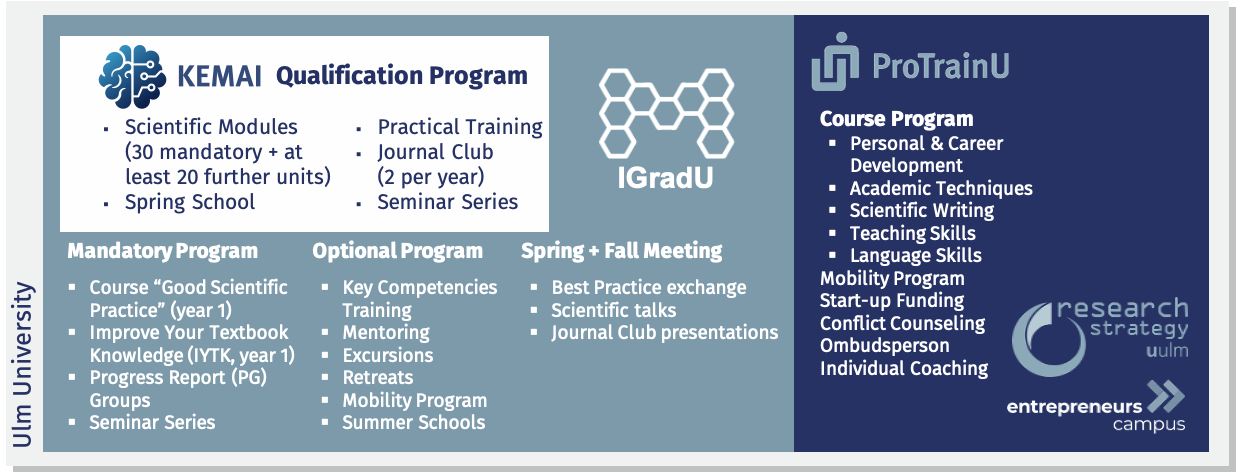
It is planned to obtain a PhD within 3-4 years, during which doctoral researchers are expected to publish 2-3 original research papers at top venues. During the entire PhD time, the doctoral researchers will receive full funding through the E13 German pay scale. Each PhD candidate within KEMAI further enjoys a range of financial benefits designed to support their research and professional development. These include €1,100 annually for Open Access publication fees, ensuring that their work reaches a wide audience without financial burden. Additionally, candidates receive sufficient travel funds, allowing them to attend international conferences, workshops, and other academic events. There is also a generous €3,300 allocation for research stays, enabling extended visits to collaborate with other institutions and experts worldwide. Furthermore, funds are available for participation in academic retreats, fostering community building and networking within the research group. Technical doctoral researchers will further be supported by a student assistant each.
Eligibility
To be eligible for the international KEMAI PhD program, you should have:
- Master’s degree: A degree completed with above-average success and overall grade of 2.0 or better (according to the German grading system) in a master’s program or a university program with a minimum standard study period of four years at a domestic or foreign university is required. The field of study should align with your KEMAI research focus. Eligible fields include, but are not limited to: Computer Science, Medicine, Bioinformatics, Biophysics, Engineering, Philosophy, Physics, Mathematics, or other related natural science disciplines.
- Analytical and problem-solving skills: Strong analytical and problem-solving skills are essential for success in the KEMAI project. Candidates should demonstrate the ability to tackle complex research questions and develop innovative solutions.
- Passion for research and innovation: A passion for research and innovation in medical AI is crucial. Candidates should be motivated to explore new frontiers in medical technology and contribute to the advancement of healthcare through artificial intelligence.
- English proficiency: Sufficient English skills are necessary to effectively communicate within the international research community. Candidates should have a minimum English proficiency level equivalent to B2 on the Common European Framework of Reference for Languages (CEFR), or an IELTS score of 6.0, or a TOEFL iBT score of 80.
How to Apply
All positions of the second cohort (start January 2027) have been filled, and applications are closed. The application form and the rolling application process are therefore no longer available. Please check this page and our news for announcements about future calls.
If you already have a PhD position that fits the topics of the RTG, you are welcome to join KEMAI as an associated PhD student or PostDoc. For any questions, please contact kemai@uni-ulm.de.